
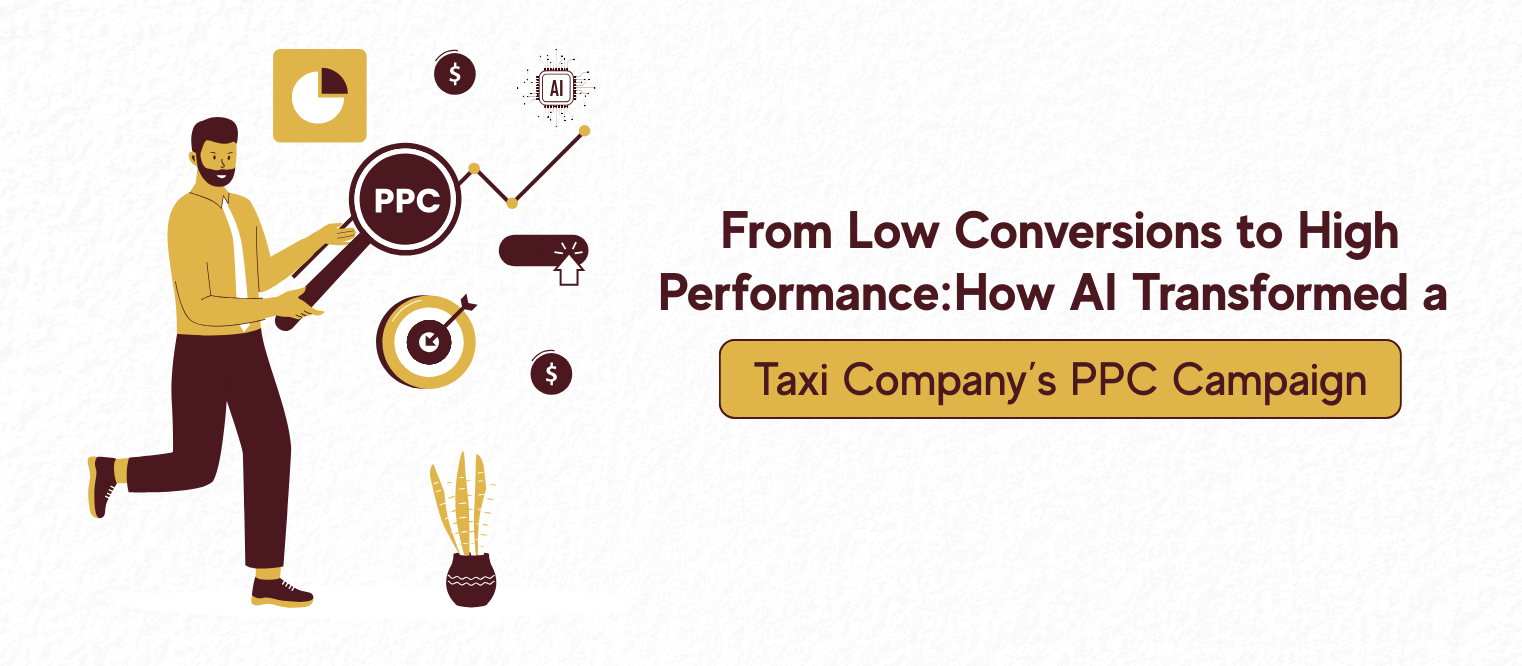
In today’s competitive digital landscape, running a PPC campaign is no longer just about selecting a few “high-intent” keywords and launching ads. Artificial Intelligence (AI) has become a game-changer in performance marketing.
In this blog, we’ll walk through a real campaign journey — how a taxi company’s PPC campaign initially struggled, how AI recommendations improved performance, and why AI is now an integral part of digital marketing strategy for agencies.
We launched a PPC campaign for a taxi company targeting:
The initial keyword strategy included service-based and location-intent keywords. Despite structured campaign planning, the results were underwhelming:
This is a situation many agencies face. Even with experience and research, performance may stagnate due to competition, user behavior shifts, or keyword mismatches.
Instead of pausing the campaign, we decided to implement AI-driven recommendations within the PPC platform.
Here’s how AI improved performance:
AI identified additional relevant search queries based on user intent patterns, improving reach without sacrificing relevance.
The system suggested excluding low-intent or unrelated search terms that were consuming budget without conversions.
Some keywords were shifted from broad match to phrase or exact match based on performance data. This significantly improved search intent alignment.
Switching to AI-powered bidding strategies such as “Maximize Conversions” allowed the platform to adjust bids dynamically based on real-time signals.
AI analyzed device usage, time-of-day searches, location behavior, and conversion trends — something nearly impossible to manually process at scale.
After implementing AI recommendations:
The campaign transitioned from manual optimization to data-driven automation.
This is where AI moves from being optional to essential.
Digital marketing platforms are now built on machine learning systems that process:
No human team can manually analyze this level of data in real time.
AI enables:
For agencies, AI doesn’t replace strategy — it strengthens execution.
Instead of viewing them as “cons,” it’s more accurate to see these as operational challenges agencies must manage strategically.
AI optimizes based on data, but it doesn’t understand business goals, seasonal trends, or competitive positioning unless guided properly.
AI-driven campaigns often go through a learning period where performance fluctuates before stabilizing.
Without proper conversion tracking, event setup, and clean data inputs, AI optimization becomes weak or misleading.
Even automated bidding strategies require regular review to prevent budget misallocation.
AI suggestions should be evaluated strategically — not blindly applied.
AI is rapidly becoming the backbone of:
The future belongs to agencies that combine:
Human Strategy + AI Execution + Continuous Testing
AI is not a shortcut. It’s a multiplier.
If your PPC campaigns are underperforming:
Instead:
✔ Analyze performance data
✔ Implement AI strategically
✔ Monitor results
✔ Optimize continuously
AI is no longer just a feature inside ad platforms — it is becoming the core engine driving modern digital marketing success.
For agencies that adapt early, AI doesn’t reduce control — it increases competitive advantage.
Comments are closed